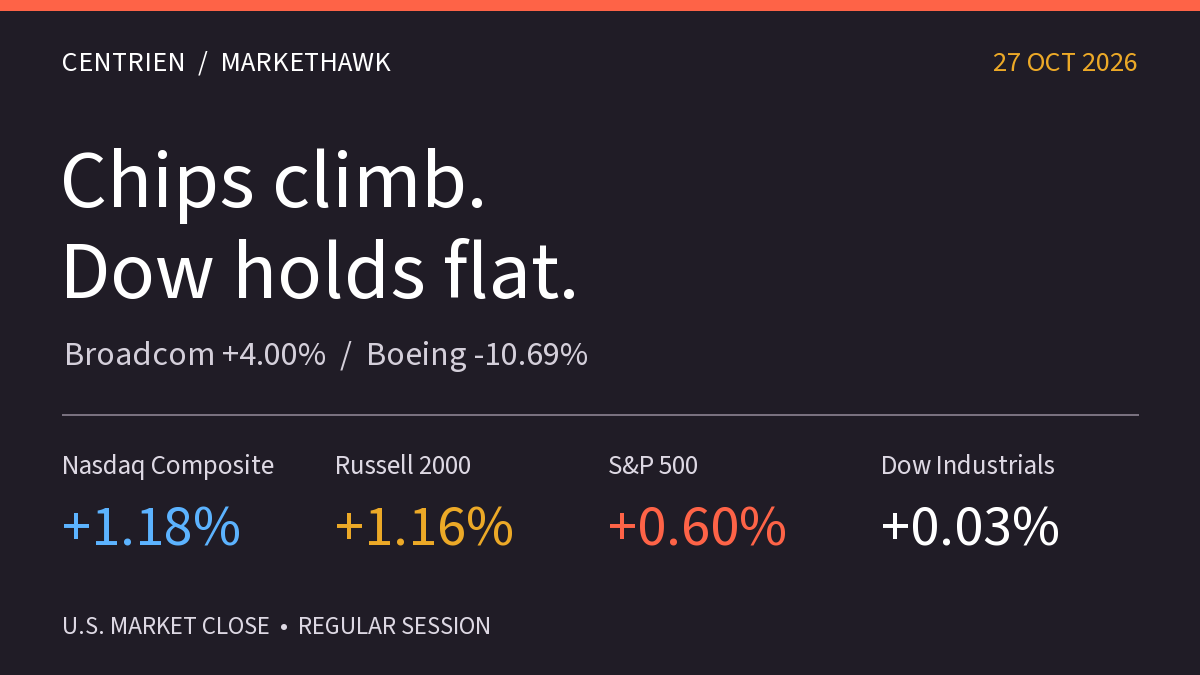
A chip-financing deal lifted Broadcom. Boeing’s results pulled the other way.
Broadcom gained 4.00% Tuesday as investors absorbed a $63 billion financing arrangement for Anthropic’s computing infrastructure. Boeing fell 10.69% following its quarterly results. The Nasdaq Composite advanced 1.18%, while the Dow Jones Industrial Average barely moved. Small caps joined the advance: the Russell 2000 gained 1.16%.
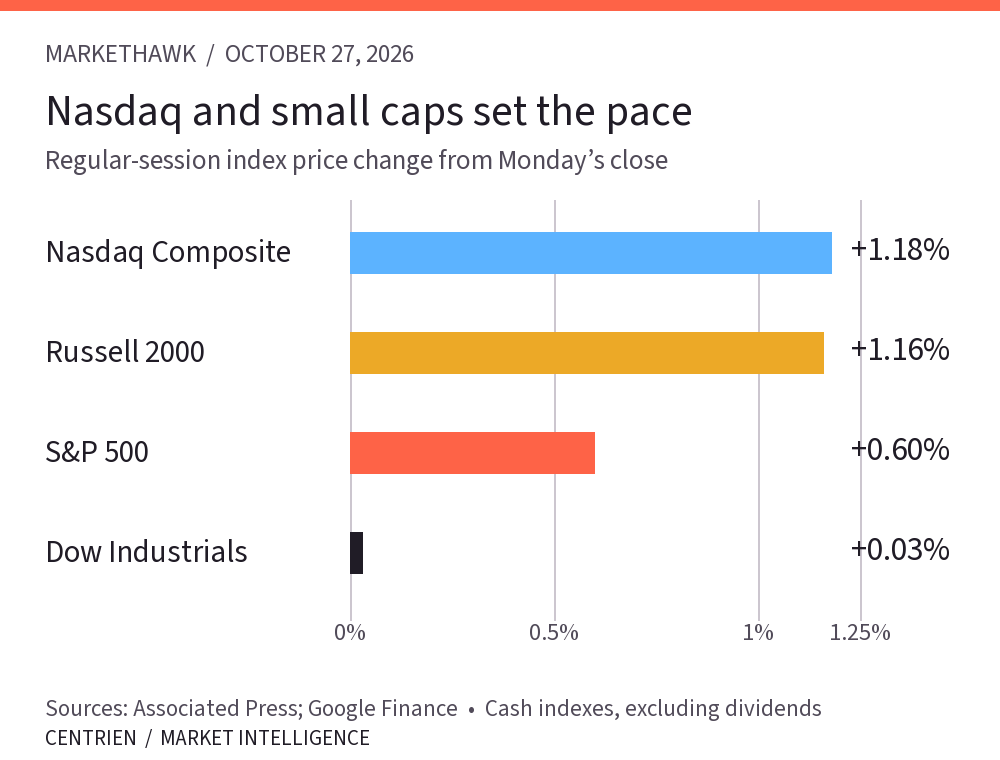
Small caps nearly match the Nasdaq
| Index | Close | Point change | Daily change |
|---|---|---|---|
| S&P 500 | 7,722.60 | +45.83 | +0.60% |
| Nasdaq Composite | 26,477.81 | +308.43 | +1.18% |
| Dow Jones Industrial Average | 52,377.57 | +15.99 | +0.03% |
| Russell 2000 | 2,818.87 | +32.45 | +1.16% |
The Russell finished within 0.02 percentage points of the Nasdaq; both outpaced the S&P 500. That is a different benchmark pattern from Monday, when small caps gained 0.38%. Yet AP reported that most S&P 500 stocks declined. Strength in a small-cap index and weakness among the typical S&P constituent can coexist because they measure different groups of companies.
Broadcom’s funding milestone, Boeing’s delivery challenge
The financing announcement was made Monday. Bank of America, Blackstone, Citi and Morgan Stanley committed financing for a vehicle that will buy Broadcom accelerators and networking equipment and lease them to Anthropic. Deliveries are expected to start in 2027. The arrangement helps address a practical constraint on AI expansion: equipment orders require capital as well as demand.
Tuesday’s stock gain reflects the market’s response to that opportunity. The $63 billion transaction is a financing structure for future equipment deployment, rather than $63 billion of revenue already recognized by Broadcom. That timing distinction matters when comparing an infrastructure announcement with a supplier’s current sales and cash flow.
Boeing’s problem was closer to the factory floor. Its third-quarter release showed $24.2 billion in revenue and a $116 million net loss. The commercial-airplane division posted a 6.5% operating loss margin, with less favorable delivery mix and higher projected production-adjustment and supply-chain costs. Boeing said its 737 program was progressing toward stable output of 47 aircraft a month. The shares closed at $168.18, down $20.13.
Technology gains meet an energy selloff
The sector contrast was clear in two traded funds: Technology Select Sector SPDR ETF (XLK) rose 1.70% to $189.49, while Energy Select Sector SPDR ETF (XLE) fell 2.05% to $68.21. These are regular-session ETF market-price returns, rather than official sector-index returns or changes in net asset value.
Oil traded lower during the U.S. session, alongside the weak energy group, according to AP’s Tuesday market update. Treasury yields were relatively steady ahead of the Fed decision. Options prices also implied lower expected volatility: the Cboe VIX quote stood at 17.52 at 3:15 p.m. Central, down 0.87 points. That decline does not settle the outcome of Wednesday’s policy announcement.
Confidence recovers; home sales remain subdued
The Conference Board’s consumer-confidence index rose to 91.7 in October from a revised 84.2 in September. Its expectations component recovered to 72.6, only partly reversing the preceding three monthly declines. The improvement gave a stronger reading on household sentiment, without establishing that spending or employment had accelerated at the same pace.
Housing supplied a more restrained comparison. Census and HUD estimated September new-home sales at a seasonally adjusted annual rate of 676,000, against a revised 680,000 in August. The estimated monthly decline was 0.6%, with a margin of error of ±13.8%; that change was not statistically distinguishable from zero. The annualized rate is a measure of sales pace, not the number of homes sold during September.
Wednesday puts policy before the next earnings reports
The next regular U.S. equity session is Wednesday, October 28. Scheduled events, in Central time:
- 9:30 a.m.: The EIA Weekly Petroleum Status Report, on its standard Wednesday release schedule.
- 1:00 p.m.: The FOMC’s policy announcement, followed by the 1:30 p.m. press conference, on the Federal Reserve’s October calendar.
- After the stock-market close: Microsoft’s fiscal first-quarter results and Alphabet’s third-quarter results. Alphabet’s announced conference call starts at 3:30 p.m. Central; the release precedes the call.
The order of events creates two distinct tests for Tuesday’s advance. The Fed can change the financing assumptions used to value future cash flows before the equity session ends. The subsequent company reports will supply operating results against which to compare the market’s enthusiasm for AI infrastructure.
Keep reading.
Your Access List Is a Museum. Time to Clean It Out.
An access review needs more than a list of active employees. Supplier accounts, service identities, inherited permissions, and active sessions can preserve access after the original reason has ended.
3 min read →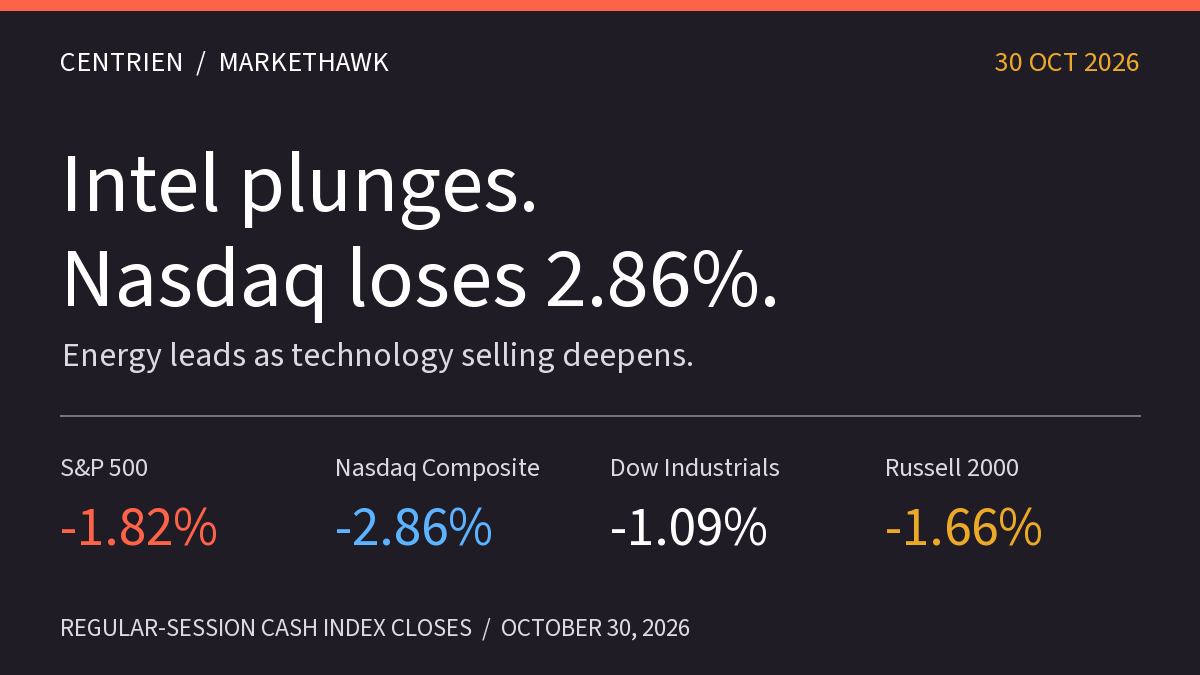
October 30 market close: Intel plunges, Nasdaq falls 2.86%
Intel falls 28.58% as its outlook weighs on technology. Nasdaq loses 2.86%, energy leads sector gains, and labor-cost data and weekly returns frame the Friday close.
4 min read →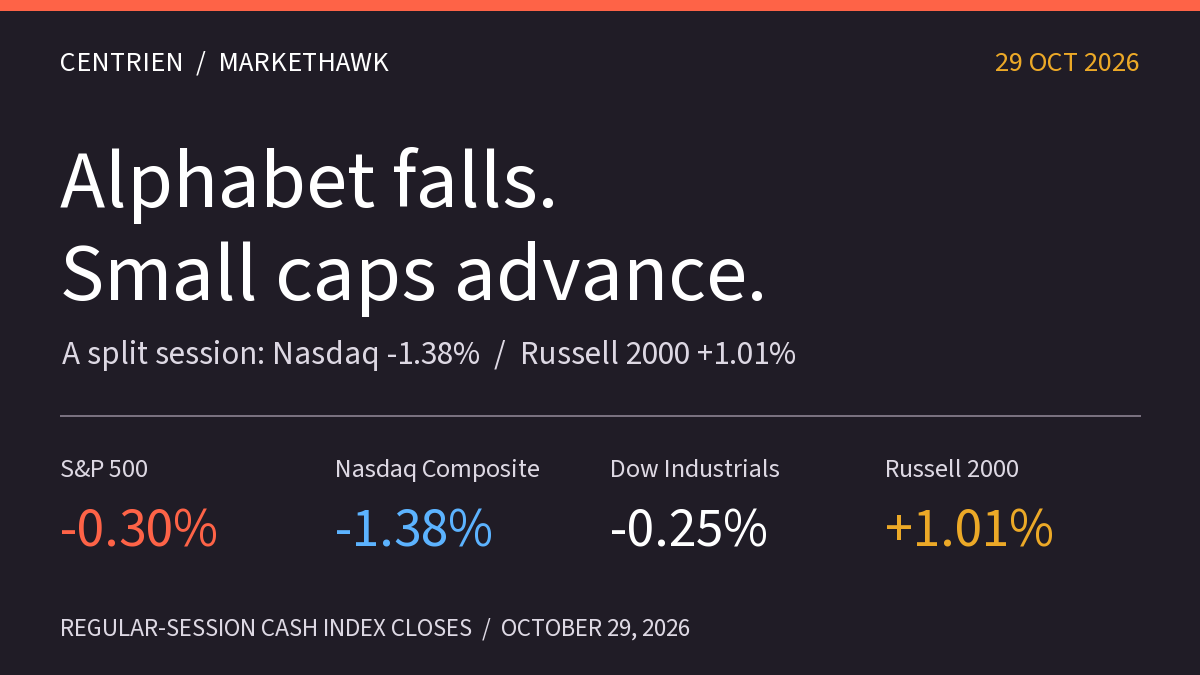
October 29 market close: Alphabet sinks, small caps advance
Alphabet falls 12.64% and the Nasdaq loses 1.38%, while small caps and nine sector ETFs gain. GDP, inflation and Amazon earnings frame a sharply divided session.
4 min read →