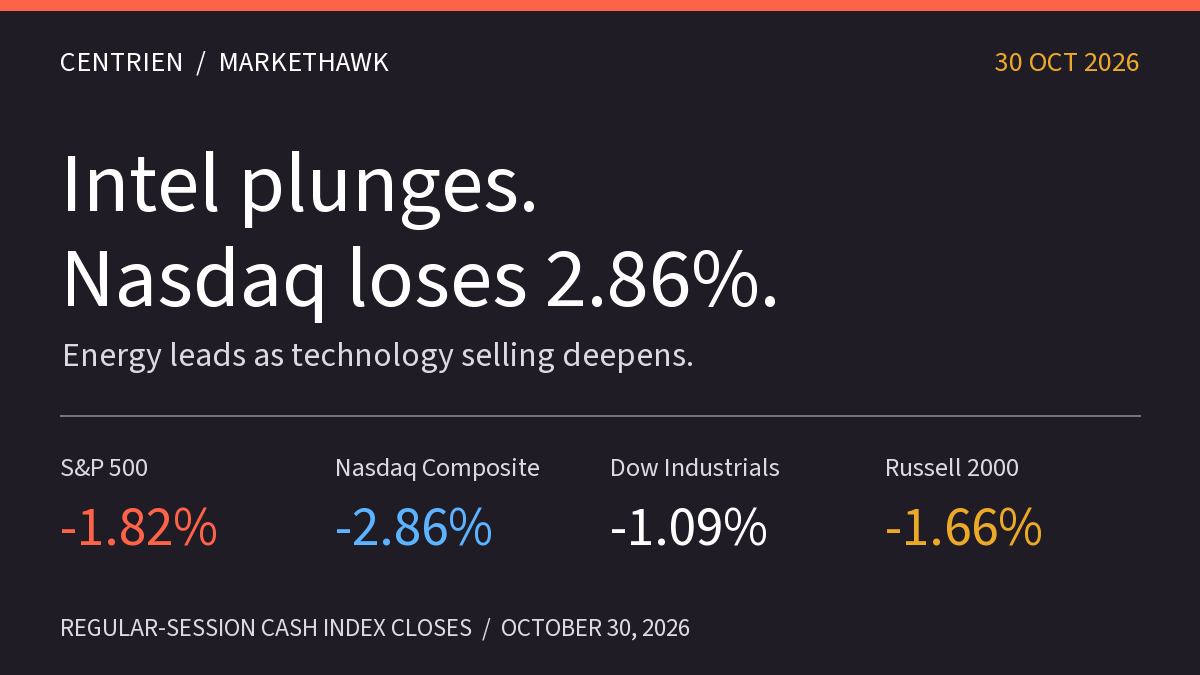
Intel fell 28.58% after its fourth-quarter outlook, and the Nasdaq Composite lost 2.86% as the technology selloff deepened Friday. All four major U.S. stock benchmarks declined. Energy and several defensive sector funds gained, but those advances could not offset the pressure on the large indexes.
Intel’s forecast mattered more than the quarter just reported
Intel closed at $65.76, down $26.31. Its Thursday earnings release reported third-quarter revenue of $16.5 billion and adjusted earnings of $0.52 a share. For the fourth quarter, however, the company projected revenue of $15 billion to $16 billion and adjusted earnings of $0.25 a share; the GAAP earnings forecast was $0.10.
AP attributed the selloff to a profit outlook below analysts’ expectations. The contrast is useful: a company can report a profitable quarter and still face a severe repricing when its forecast changes the expected earnings path. Intel’s reported results and its guidance cover different quarters, and its adjusted figures are distinct from GAAP earnings.
Amazon finished at $240.35, down 1.41%, in the first regular session after its results. The company’s Thursday release reported trailing-twelve-month free cash outflow of $42.4 billion amid higher infrastructure spending. That cash requirement remains a different measure from the growth of its cloud revenue. Both companies’ releases preceded Friday’s trading; the share-price changes here are regular-session returns.
Friday turned the large benchmarks lower for the week
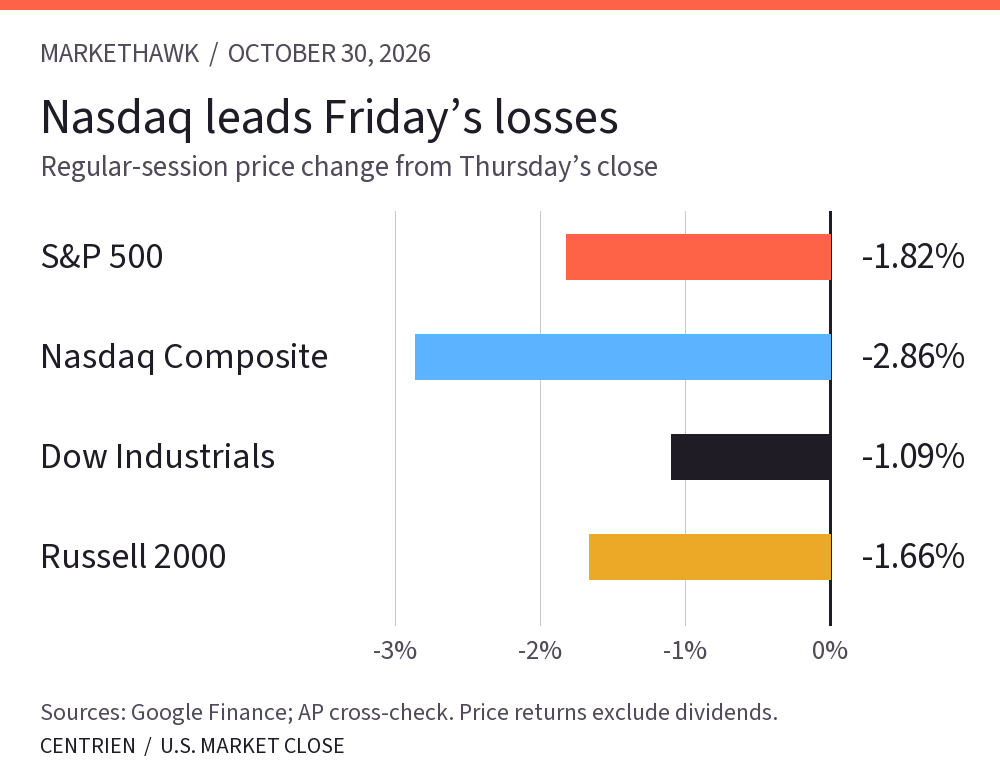
The S&P 500 fell 1.82%, the Dow 1.09% and the Russell 2000 1.66%, alongside the Nasdaq’s 2.86% loss. The closing levels and point changes below agree with the AP session scorecard. Returns are cash-index price changes, excluding dividends.
| Index / source | Close | Point change | Price change |
|---|---|---|---|
| S&P 500 | 7,580.07 | -140.32 | -1.82% |
| Nasdaq Composite | 25,437.00 | -747.73 | -2.86% |
| Dow Industrials | 51,770.31 | -572.25 | -1.09% |
| Russell 2000 | 2,811.84 | -47.37 | -1.66% |
For the full week, AP’s rounded price returns were negative 0.6% for the S&P 500, negative 0.9% for the Dow and negative 2.0% for the Nasdaq. The Russell retained a 1.3% weekly gain despite Friday’s decline. Small caps therefore ended ahead over five sessions even though they offered no protection from the final day’s selling.
Energy gained while technology lost nearly 5%
The technology sector ETF, XLK, fell 4.89%, substantially more than any of the four broad benchmarks. Industrials’ XLI lost 1.60% and communication services’ XLC declined 1.29%.
Six of the eleven Select Sector SPDR funds nevertheless rose. Energy’s XLE led with a 1.91% gain, followed by consumer staples’ XLP at 1.41%. Utilities, health care, materials and real estate also advanced. These are regular-session ETF price returns used as sector proxies, rather than dividend-inclusive returns or the underlying sector indexes.
Energy’s resilience coincided with oil-major earnings. Chevron reported quarterly earnings of $9.9 billion, or $5.06 a share; adjusted earnings were $10.4 billion, or $5.28 a share. Its U.S. refineries ran at 98% crude utilization. Those operating results help explain the sector’s different business conditions, without establishing that every energy company benefited equally.
Google Finance’s NYMEX continuous crude-oil series, CLW00, showed $102.95 a barrel, up 0.93%, at 4:00 p.m. Central. This is a timestamped futures-series observation, not a settlement price.
Compensation growth eased; bond yields fell
The Employment Cost Index, released at 7:30 a.m. Central, showed civilian compensation costs rising 0.8% in the three months ended September, seasonally adjusted, after 0.9% in the prior quarter. Wages and salaries rose 0.7%, while benefits increased 0.9%. Over twelve months, total compensation increased 3.4% on an unadjusted basis.
The quarterly slowdown adds information about labor costs, but it does not erase the price pressures in Thursday’s inflation data. The quarter-to-quarter and year-over-year ECI measures also have different seasonal treatments and should not be compared as if they were the same rate.
AP’s end-of-day report put the ten-year Treasury yield at 4.93%, versus 4.98% late Thursday. The VIX observation was 19.42, up 2.22 points, at 3:15 p.m. Central. Lower Treasury yields alongside a higher volatility reading show that the equity decline was accompanied by a repricing of risk beyond individual earnings announcements.
Manufacturing data opens November
The next regular U.S. equity session is Monday, November 2. The times below are Central Standard Time, following the weekend clock change:
- 9:00 a.m.: October’s ISM Manufacturing report and September construction spending.
- After the market close: Palantir’s third-quarter results, with its webcast scheduled for 4:00 p.m. Central.
Manufacturing activity and construction spending will provide a different test of demand from the technology earnings that dominated Friday. Palantir’s results will then add another company-specific measure of growth and profitability after Monday’s cash session ends.
Keep reading.
Your Access List Is a Museum. Time to Clean It Out.
An access review needs more than a list of active employees. Supplier accounts, service identities, inherited permissions, and active sessions can preserve access after the original reason has ended.
3 min read →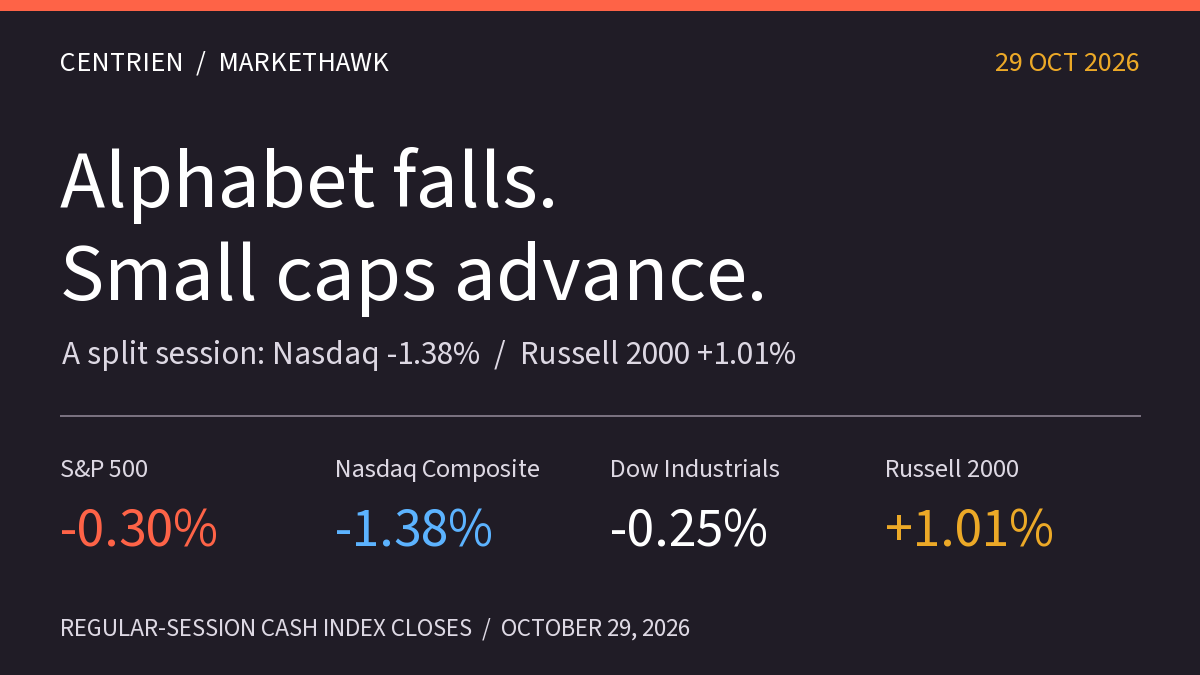
October 29 market close: Alphabet sinks, small caps advance
Alphabet falls 12.64% and the Nasdaq loses 1.38%, while small caps and nine sector ETFs gain. GDP, inflation and Amazon earnings frame a sharply divided session.
4 min read →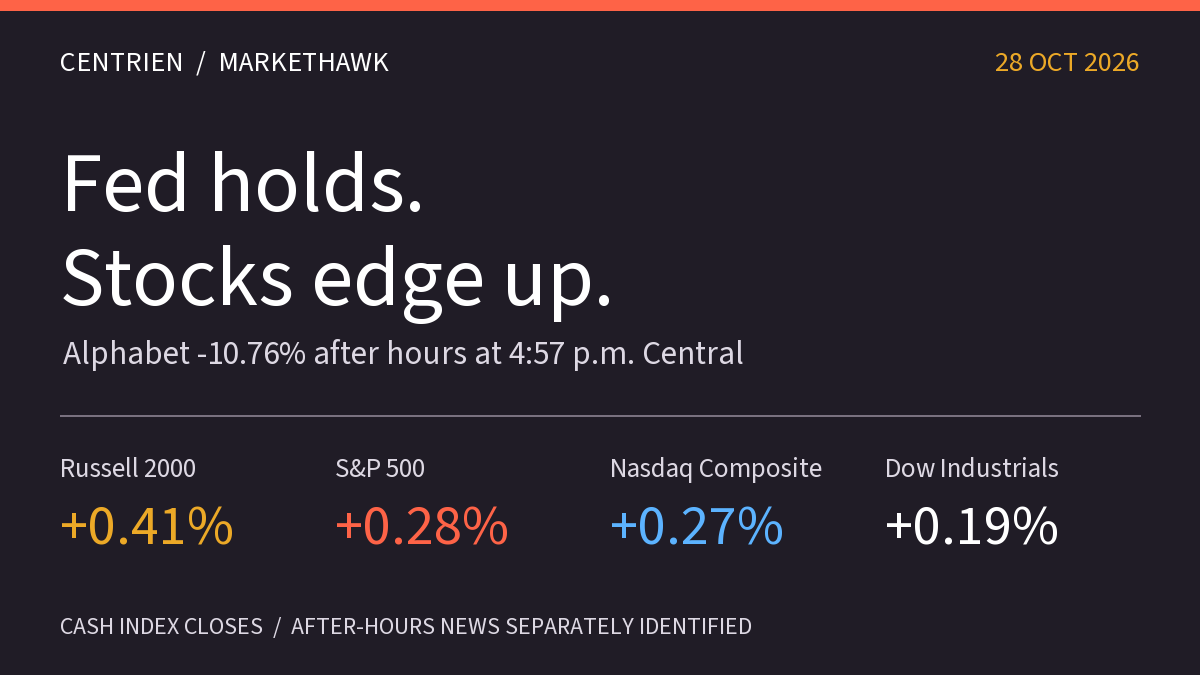
October 28 market close: Fed holds, Alphabet drops after hours
The Fed holds rates at 3.75%–4.00% in a split vote. Cash indexes edge higher, while Alphabet’s late after-hours decline sets a different test ahead of Thursday’s GDP and inflation data.
4 min read →