Recovery is an operating capability.
Follow the path from a critical business service to a clear recovery-readiness decision.
An animated guide to scoping a recovery test, validating the business operation, and closing the loop on readiness.
Read the video transcript
Centrien. Stronger systems. Stronger business.
Start with one critical business service. Map the people, applications, infrastructure, and data it depends on. Set your recovery objectives, and decide what a successful test must demonstrate.
Restore into an isolated environment. Run a representative business transaction, confirm access, and reconcile the data. Measure the recovery time and recovery point against the business requirements.
Give every exception an owner. Correct the gaps, then retest. Readiness is a decision, backed by what the test actually demonstrated.
Centrien. Let's move your business forward.
Download transcriptWhy it matters
Almost every organization has a disaster recovery plan. Far fewer have ever restored from it. A plan you have not tested is a document, not a capability, and the difference becomes painfully clear on the one day you need it.
The comfortable lie
The comfortable lie is the green checkmark. Backups ran, the job reported success, everyone moved on. But a backup that completes is not the same as a backup that restores. Files corrupt silently. Retention windows quietly shorten. The one system nobody backed up turns out to be the one that holds everything together. You find all of this out during the restore, which is the worst possible time to find it out.
What a real test involves
A real test restores something, to somewhere, and proves it works. You pick a system, stand it up from backup in an isolated environment, and confirm it actually runs — not that the files copied, but that the application starts, the data is intact, and a person can log in and do the work. You time it, because “we can recover” means nothing without “by when.” And you write down what broke, because something always breaks the first time.
You do this before the ransomware note, the failed drive, or the flooded server room. The teams that recover in hours instead of weeks are not lucky. They rehearsed. They know their recovery time because they have measured it, and they fixed the surprises in a drill instead of in a crisis.
The reason this gets skipped is that it is nobody’s favorite afternoon. It is also the single highest-leverage thing most organizations can do to survive a bad day. We run these tests as a scheduled discipline — restore, verify, time, and fix — so that when the real outage comes, the answer to “are we covered?” is a rehearsed yes, not a hopeful one.
If you cannot name the last time you restored from backup, you do not have a recovery plan. You have a wish.
What published breach research adds
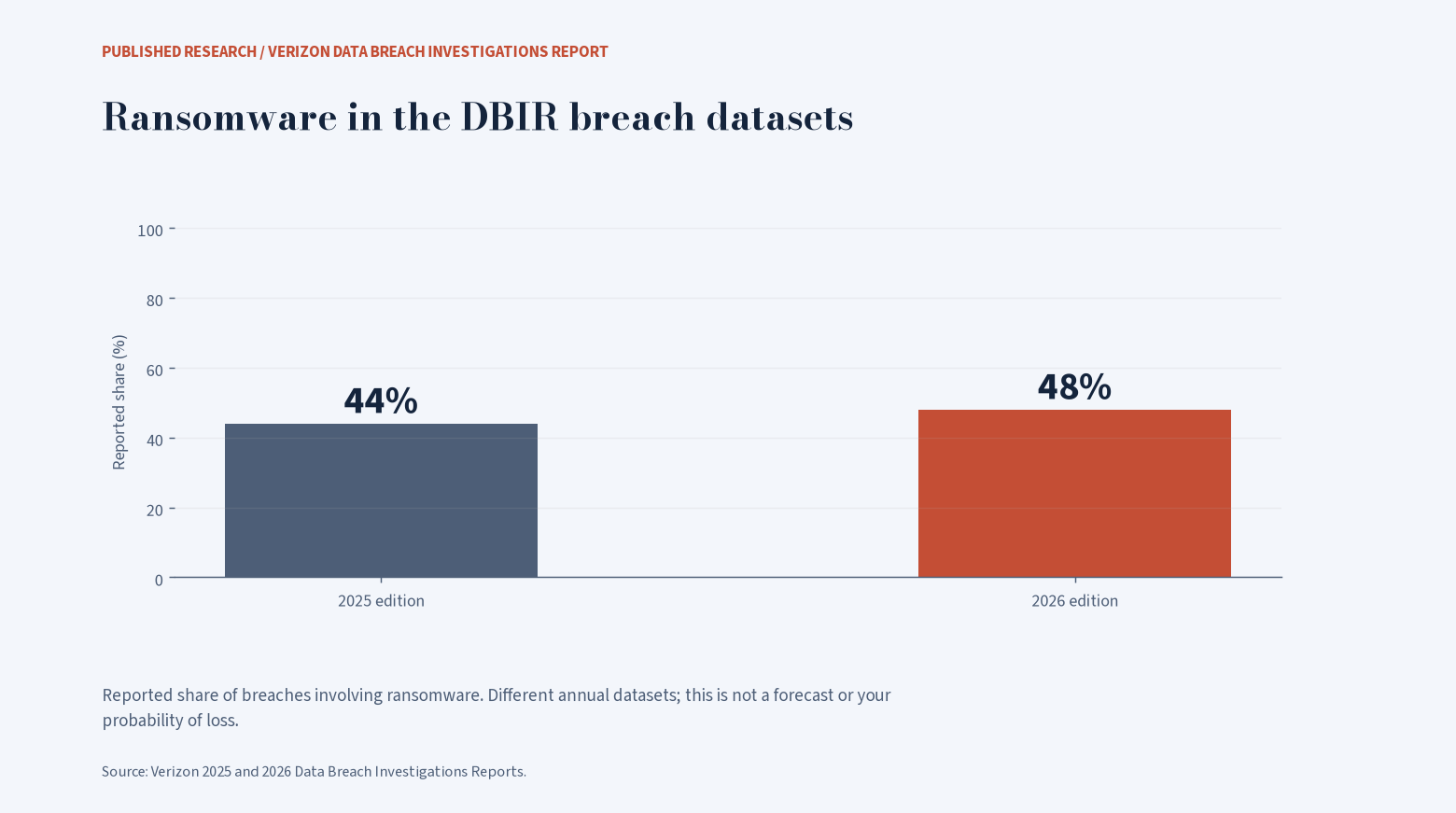
| Report edition | Reported share |
|---|---|
| 2025 edition | 44% |
| 2026 edition | 48% |
Use the finding to choose a relevant validation exercise, not to assign this percentage to your organization. Report editions describe contributed historical datasets; they do not measure the incidence of breaches across every organization.
Put it into practice
The practical starting point
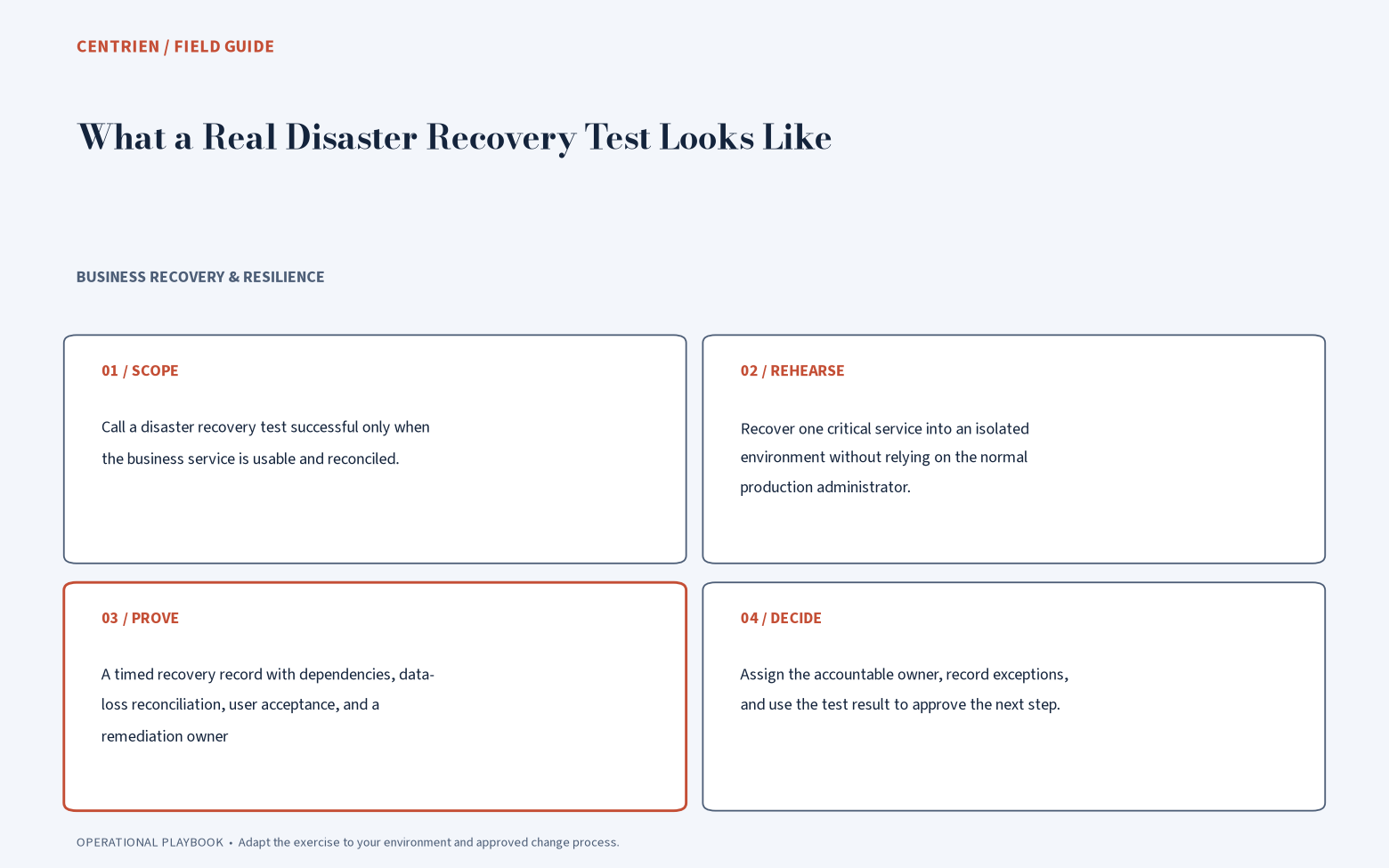
Recover one critical service into an isolated environment without relying on the normal production administrator. Include identity, DNS, secrets, software, data, and downstream integrations. Ask a business user to validate representative transactions before stopping the recovery clock.
Implementation steps
Use this sequence to assign responsibilities, test controls, and document outcomes. Set the scope and acceptance criteria for the service before you begin.
- Set the service objectiveAgree the business process to restore, maximum tolerable disruption, and acceptable data loss. Recovery time objective and recovery point objective describe different limits and must be recorded separately.
- Map the prerequisitesInclude identity, DNS, secrets, certificates, installation media, configuration, data, network access, SaaS dependencies, and people. Confirm emergency access can work without the failed primary environment.
- Recover in isolationRestore a representative service in a controlled environment and record each phase. Verify data integrity and reconcile missing transactions. A successful backup job establishes copy creation, not business recoverability.
- Obtain business acceptanceHave a user execute representative work and validate the results. Compare observed recovery with the agreed objective, document gaps and owners, and rehearse again after material dependency changes.
What to measure
Define the population and decision before choosing a target. The same percentage can conceal missing assets, untested cases, or evidence outside the review period. Keep the underlying counts so someone else can reproduce the result.
| Measure | Calculation or definition | How to use it |
|---|---|---|
| Observed recovery time | Business acceptance timestamp minus agreed disruption start | Include prerequisites and validation, not only file-copy time. |
| Observed data loss | Incident cutoff minus latest verified recovered transaction | Measure the recovered data rather than the configured backup schedule. |
| Recovery coverage | Critical services with accepted recovery tests / critical services | Show untested integrations and emergency access as explicit gaps. |
Worked example: read the denominator
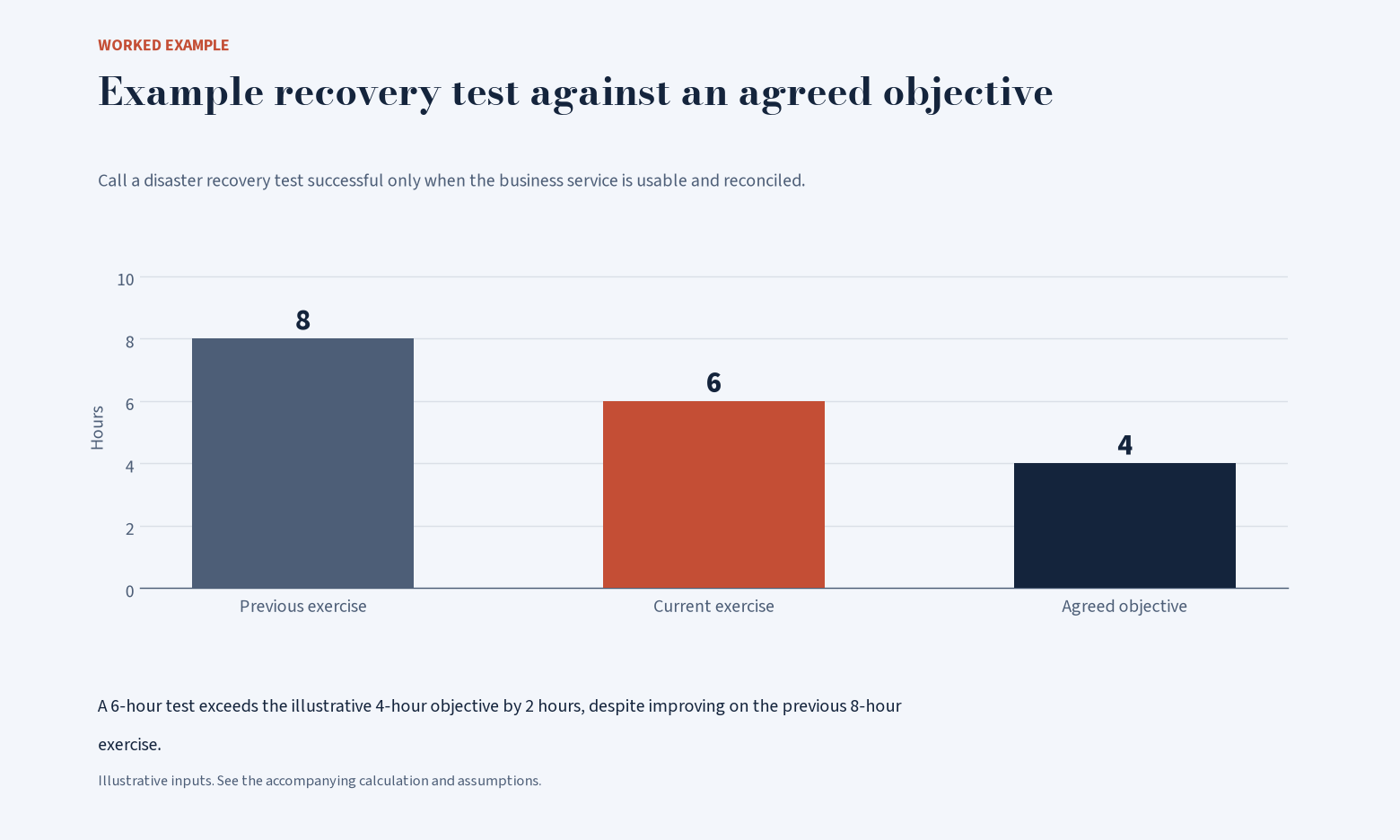
Worked example. Figures are illustrative.
| Observation | Hours |
|---|---|
| Previous exercise | 8 |
| Current exercise | 6 |
| Agreed objective | 4 |
Interpretation
A 6-hour test exceeds the illustrative 4-hour objective by 2 hours, despite improving on the previous 8-hour exercise.
Set the recovery objective with the business owner before the exercise.
Use your own operating data and record the reporting period, scope, exclusions, and accountable owner.
Documentation and acceptance criteria
The deliverable: A timed recovery record with dependencies, data-loss reconciliation, user acceptance, and a remediation owner.
Keep the scope and source records alongside the operator, date, expected outcome, actual result, and approving owner. Record what was not tested and any remaining exception. Have a reviewer reproduce one material conclusion from the original evidence before marking the work complete.
Next step: Start with the exercise above, assign an owner, and agree on the acceptance criteria. Review the results before expanding the work.
References
- NIST SP 800-34 Rev. 1: Contingency Planning — Use impact analysis, recovery priorities, exercises, and plan maintenance to structure continuity work.
- NIST SP 800-61 Rev. 3: Incident Response — Connect preparation, detection, response, and recovery with the wider risk-management program.
Keep reading.

The End-of-Year IT Checklist Nobody Enjoys but Everyone Needs
Finish the year with verified service ownership and recovery readiness, rather than an unchecked task list. Review critical assets, account owners, contract renewals, certificate expiries, and the latest successful restore.
5 min read →
Compliance Frameworks Are Converging. Map Once, Report Many.
Reuse control evidence across frameworks only after confirming scope and assessment differences. Pick access review as a common control.
5 min read →Refrigeration Alarms at 2 A.M.: Building a Response Plan That Works
Give a refrigeration alarm a response path that protects product and supports a sound disposition decision. Test sensor health, sustained alarm logic, acknowledgement, dispatch, and an alternative storage arrangement.
5 min read →