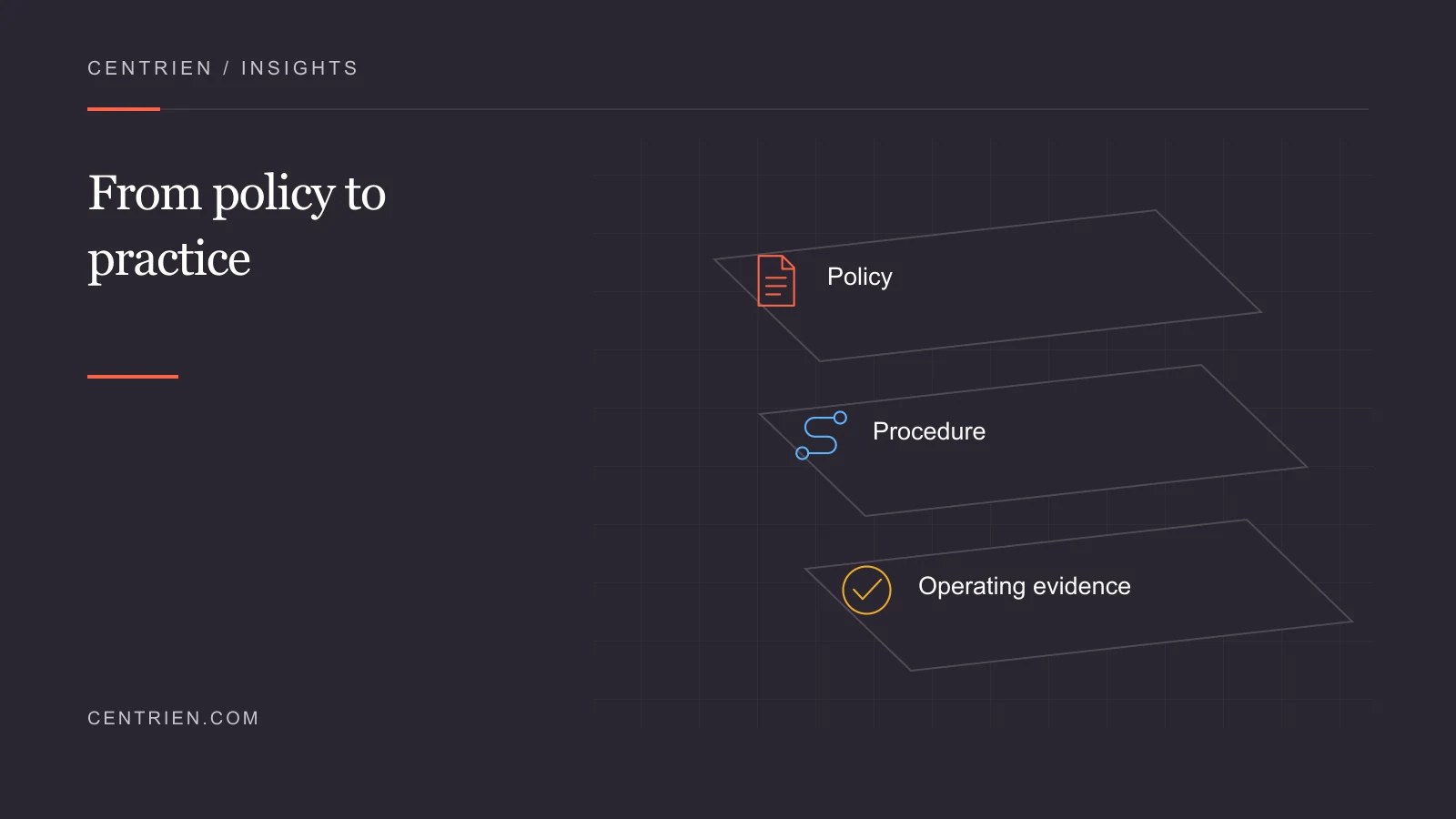
Give each document a distinct job
People need different answers from a policy and a procedure. A policy states management’s intent. A standard sets mandatory requirements. A procedure describes the steps to carry out a task, while a plan organizes a response or a course of work.
Use a familiar task to check the distinction. For access removal, the policy establishes responsibility, the standard defines required timing, and the procedure identifies the systems and actions involved. Assign an owner to each document and reconcile contradictions before asking staff to follow it.
Put it into practice
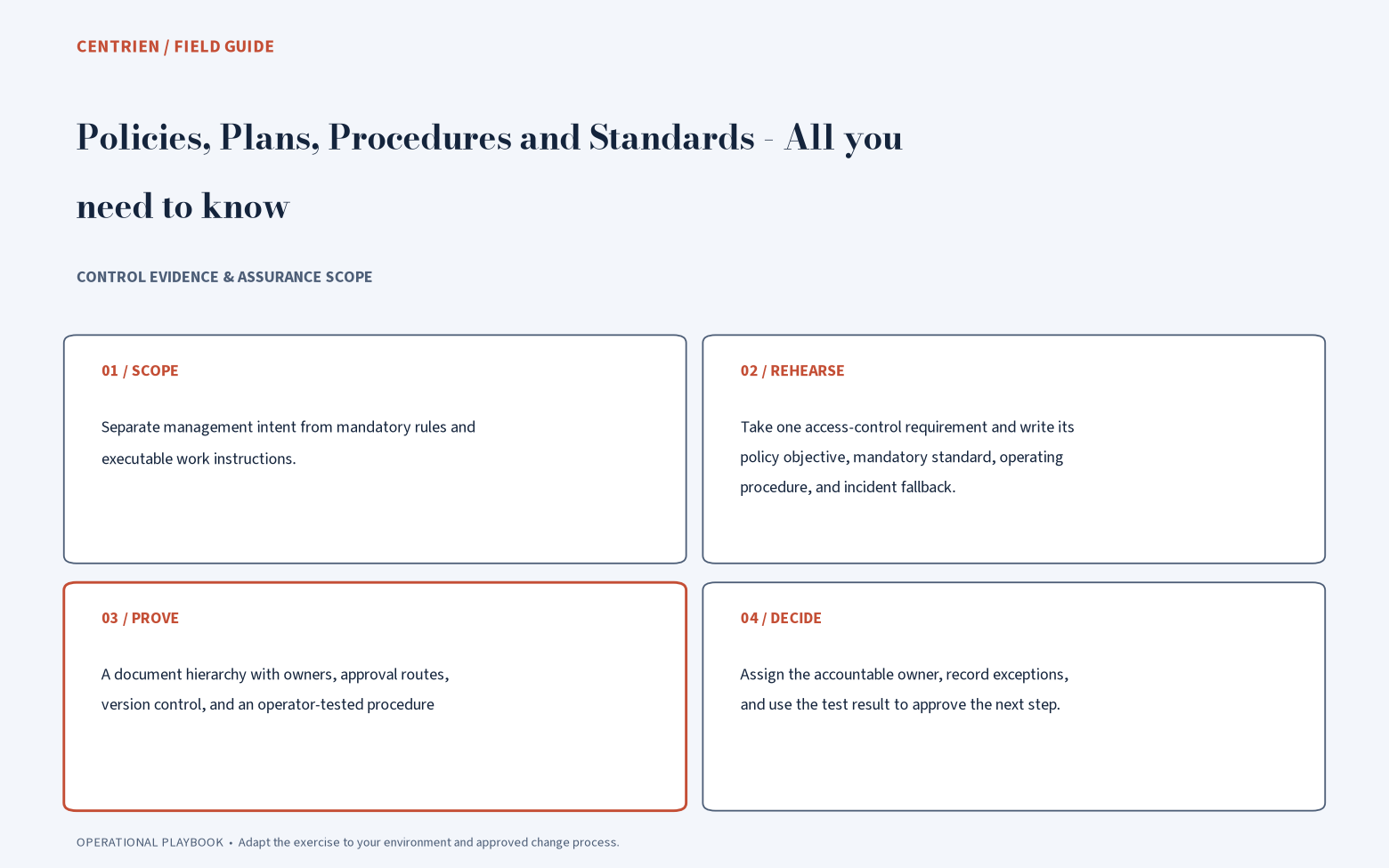
Take one access-control requirement and write its policy objective, mandatory standard, operating procedure, and incident fallback. Ask an unfamiliar operator to execute the procedure and record where the document leaves a decision unspecified.
Implementation steps
- State the management requirement Choose one task and write the policy intent and accountable owner. Identify which standards are mandatory and who may authorize an exception.
- Write the operating route Turn the requirement into steps, inputs, decisions, and escalation contacts. Keep the incident or fallback plan linked to the task, with clear authority to invoke it.
- Test and control the documents Ask an unfamiliar authorized operator to follow the procedure in a safe test. Resolve ambiguous steps, approve the revision, and make the current version easy to find.
Track population coverage and evidence freshness
| Measure | Calculation or definition | How to use it |
|---|---|---|
| Population coverage | Control items with evidence / total applicable population | Record exclusions and sampling limits alongside the percentage. |
| Evidence freshness | Evidence within the required review period / evidence reviewed | Use the actual obligation or control cadence for the cutoff. |
| Verified remediation | Failed controls retested successfully / failed controls reported fixed | Keep evidence gaps distinct from confirmed control failures. |
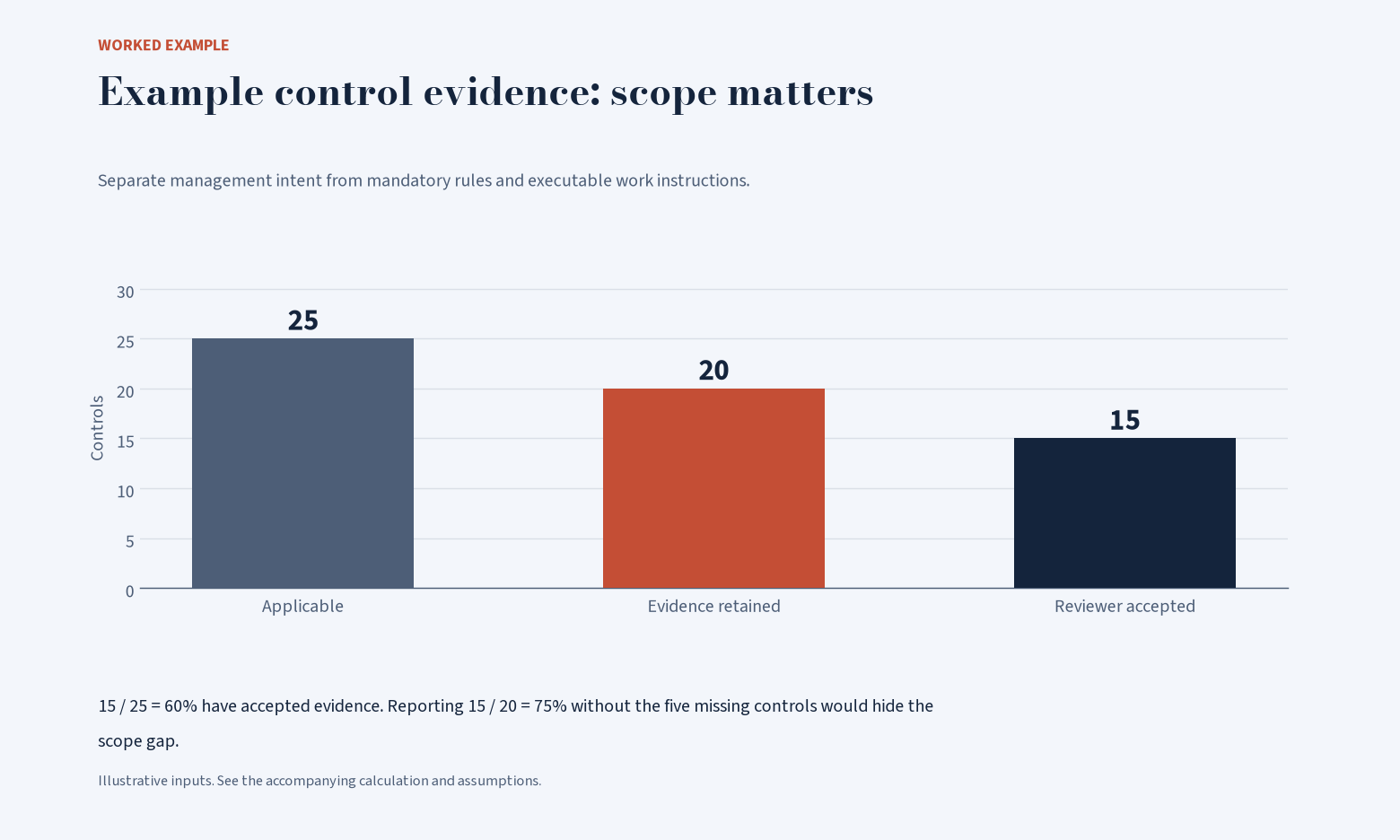
Example control evidence: scope matters
Worked example. Figures are illustrative.
| Observation | Controls |
|---|---|
| Applicable | 25 |
| Evidence retained | 20 |
| Reviewer accepted | 15 |
Keep all applicable controls in the denominator, including those with missing evidence.
The record to keep
The deliverable: A document hierarchy with owners, approval routes, version control, and an operator-tested procedure.
Give the documents to someone who did not write them. If that person cannot identify the required action, the decision-maker, and the applicable deadline, revise the instructions before publishing another version.
References
- NIST Cybersecurity Framework — Use outcomes and organizational context to organize the risk discussion; a framework mapping is not a control test.
- NIST SP 800-218: Secure Software Development Framework — Organize secure development, software protection, vulnerability response, and supplier communication.
Keep reading.
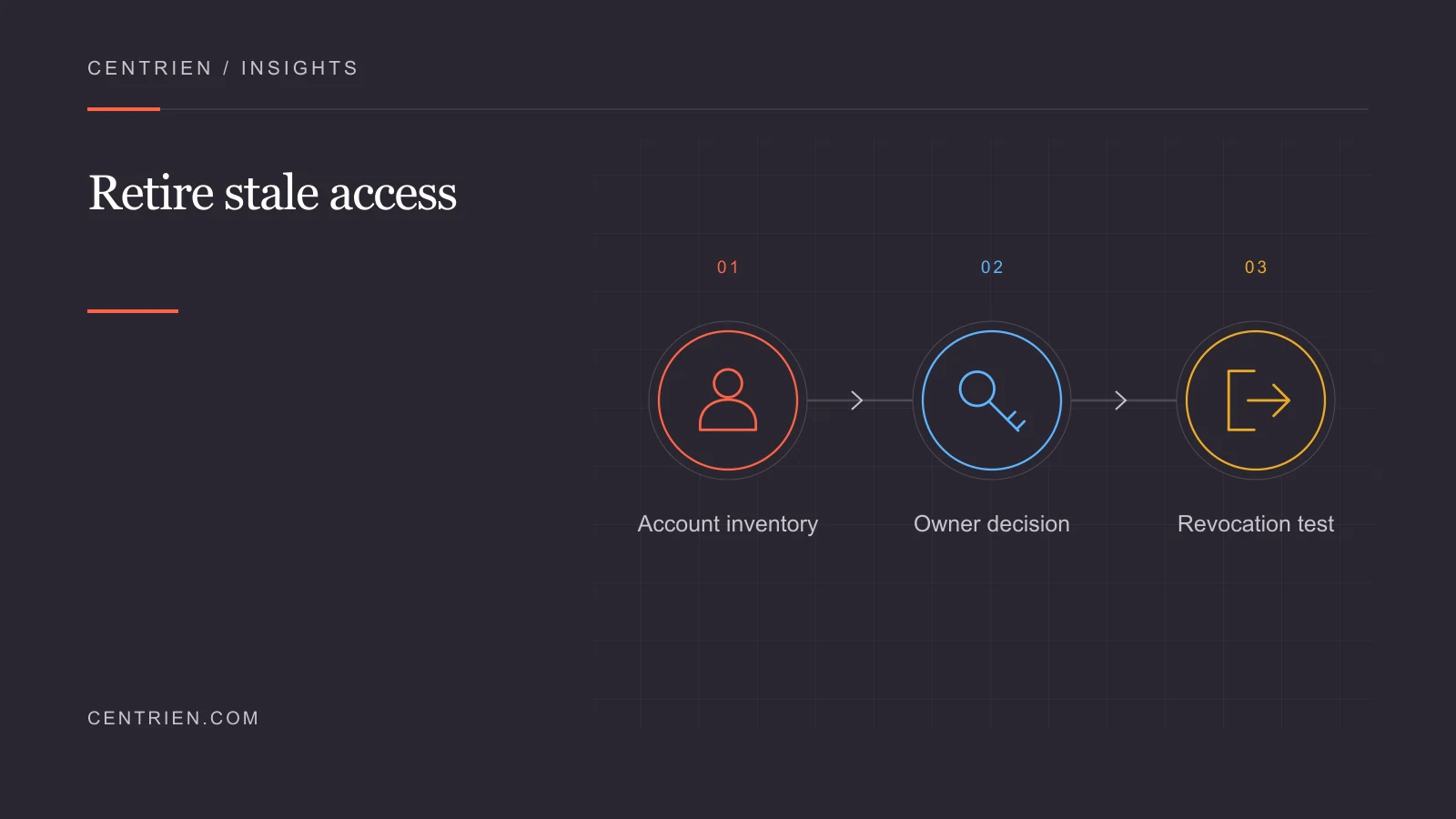
Your Access List Is a Museum. Time to Clean It Out.
An access review needs more than a list of active employees. Supplier accounts, service identities, inherited permissions, and active sessions can preserve access after the original reason has ended.
3 min read →
October 30 market close: Intel plunges, Nasdaq falls 2.86%
Intel falls 28.58% as its outlook weighs on technology. Nasdaq loses 2.86%, energy leads sector gains, and labor-cost data and weekly returns frame the Friday close.
4 min read →
October 29 market close: Alphabet sinks, small caps advance
Alphabet falls 12.64% and the Nasdaq loses 1.38%, while small caps and nine sector ETFs gain. GDP, inflation and Amazon earnings frame a sharply divided session.
4 min read →