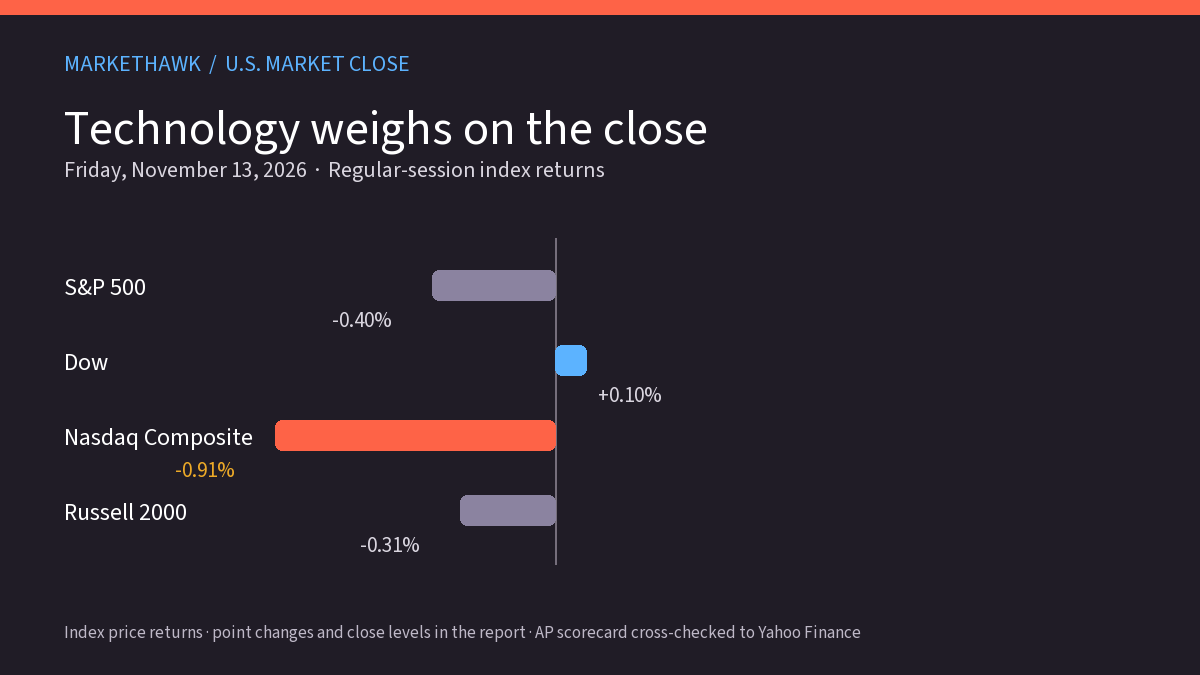
Friday’s close split the major indexes: the Dow edged higher while the S&P 500, Nasdaq Composite and Russell 2000 declined. The Nasdaq’s larger loss reflected another weak day for big technology and AI-linked names, even as more than 60% of S&P 500 constituents advanced. The broader participation helped keep the S&P’s decline modest; it could not outweigh the market’s concentration in a small number of large companies.
The Dow gained 50 points as the Nasdaq lost 230
The S&P 500 fell 30.73 points to 7,561.67 (0.40%). The Dow added 50.46 points to 52,347.55 (0.10%), while the Nasdaq Composite dropped 229.82 points to 25,136.27 (0.91%). The Russell 2000 declined 8.57 points to 2,790.49 (0.31%). These are regular-session cash-index price changes, without dividends. AP’s closing scorecard reports the same levels and point moves; historical closes were cross-checked against Yahoo Finance.
| Index | Close | Point change | Price change |
|---|---|---|---|
| S&P 500 | 7,561.67 | -30.73 | -0.40% |
| Dow Jones Industrial Average | 52,347.55 | +50.46 | +0.10% |
| Nasdaq Composite | 25,136.27 | -229.82 | -0.91% |
| Russell 2000 | 2,790.49 | -8.57 | -0.31% |
Friday gave back some of the week’s recovery, but not all of it. The S&P 500 still finished up 2.5% for the week, its first weekly gain since early October. The Dow rose 2.1%, the Nasdaq 2.3% and the Russell 2000 1.3%, according to AP’s week-end comparison. One mixed day therefore did not erase the rebound in the weekly totals.
Large technology names pulled against stronger market breadth
Technology stocks remained the heaviest influence on the broad indexes. Nvidia fell another 2% following Thursday’s CEO departure; Broadcom dropped 4.8% and AMD 8.8%, reversing part of the gains those chipmakers had made earlier in the week. AP reported that more than 60% of S&P 500 constituents rose on Friday, with health-care and financial companies among the gainers. The difference between index performance and the number of advancing stocks shows how a handful of heavily weighted companies can dominate a capitalization-weighted benchmark.
The week’s technology swings followed Nvidia’s announcement that Jensen Huang had resigned and CFO Colette Kress would serve as interim CEO. The company has scheduled its fiscal third-quarter results for Tuesday, November 17, at approximately 1:20 p.m. Pacific (3:20 p.m. Central), followed by a 2:00 p.m. Pacific earnings call. That event is ahead, not part of Friday’s session.
Monthly producer inflation cooled; the annual rate accelerated
The October Producer Price Index rose 0.3% from September, after a 1.4% monthly increase in September. On a 12-month basis, final-demand prices were up 6.5%, compared with 6.3% in September. The Bureau of Labor Statistics release shows the two measures moving in different directions: the monthly pace eased, while the annual rate reached its highest level since November 2022. PPI tracks prices received by domestic producers; it is an upstream inflation measure, not a direct reading of household expenses.
The 10-year Treasury yield rose to 5.15% from 5.10% late Thursday, AP reported. Oil prices were little changed. Together, the data and bond move left the market weighing slower monthly producer-price growth against the still-elevated annual measure and higher longer-term borrowing costs. The day’s stock moves alone do not establish which of those signals mattered most to individual investors.
New York manufacturing survey opens Monday
The next U.S. equity session is Monday, November 16, on the regular exchange schedule. The New York Fed’s calendar lists the Empire State Manufacturing Survey for Monday; it will provide a regional view of factory activity. Nvidia’s results follow Tuesday afternoon. The company’s investor-relations notice confirms the November 17 release and call times.
Keep reading.
Winterizing Commercial HVAC Before the First Hard Freeze
Preparing commercial heating equipment for winter requires attention to safe operation, controls, support, and the site's operating needs. The work should follow the equipment manufacturer's requirements and qualified technical judgement.
3 min read →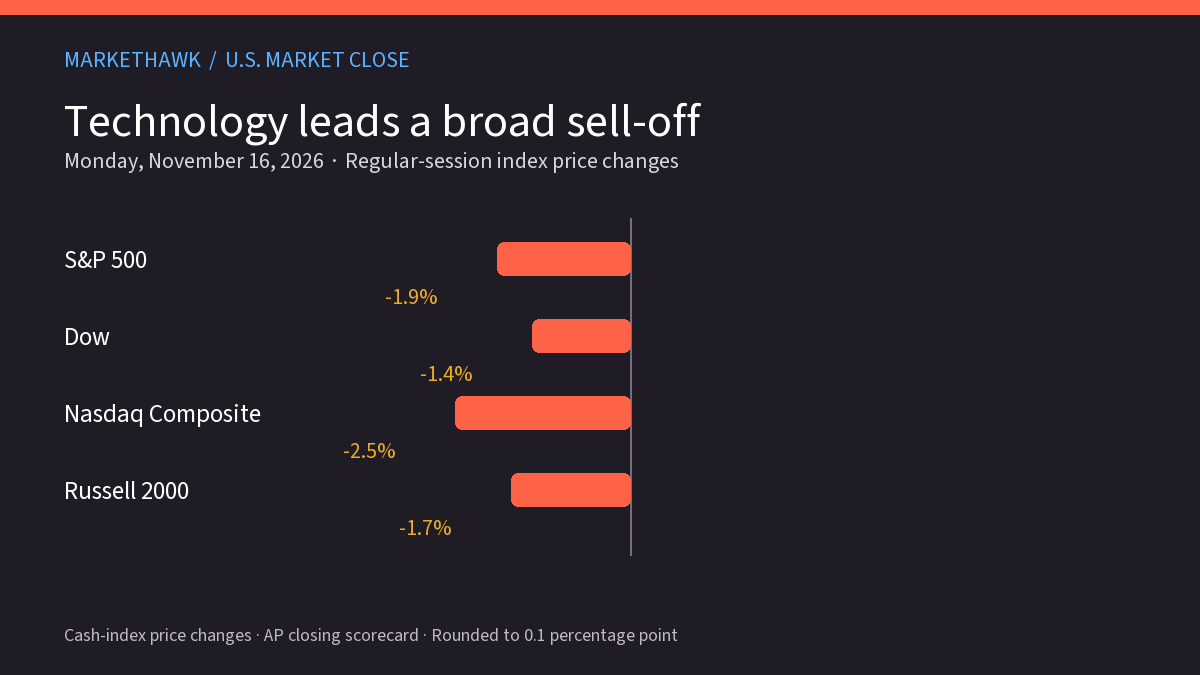
Technology Sell-Off Pulls U.S. Indexes Lower
Technology and chip shares led Monday’s losses. The Nasdaq fell 2.5%, the S&P 500 logged a third straight decline, and investors looked ahead to retail sales and Nvidia results.
4 min read →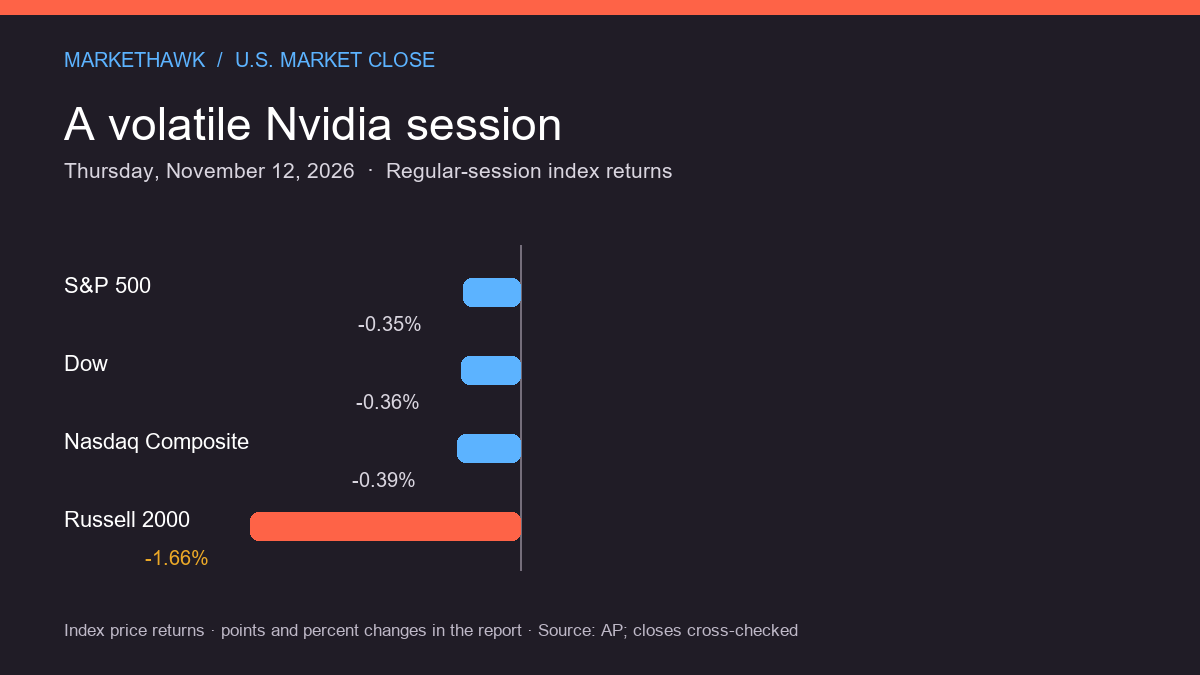
Nvidia’s CEO Exit Jolts Stocks; Oil Rises as Indexes Recover From Early Losses
Nvidia shares plunged after the CEO transition announcement, then pared losses. Energy outperformed, oil rose, and all four major U.S. indexes finished lower.
3 min read →