Why it matters
The last quarter of the year is when the technology you ignored all year sends its invoice. Licenses auto-renew, warranties lapse, and the one server everyone forgot about chooses December to fail. A short, honest checklist in October is cheaper than a surprise in December.
What belongs on it
Start with inventory: know every device, license, and service you are paying for, because you cannot secure or budget for what you cannot see. Confirm backups actually restore, not just that the job reports success. Review who has access to what and remove the accounts of people who left. Check that warranties and support contracts on critical equipment are current before the busy season, not after an outage.
The planning half
Then look forward. Which systems are one bad day from end-of-life? Where did you spend the year firefighting the same problem? What did a near-miss teach you that you have not yet fixed? The checklist is not busywork; it is the difference between entering the new year ahead of your technology or behind it.
The reason this gets skipped is that it belongs to everyone and therefore no one. When your IT, security, and facilities answer to one accountable partner, the year-end review happens because it is somebody’s job, and the surprises get found in October instead of discovered in a crisis. Walk into the new year knowing what you own and what needs attention. That clarity is worth an afternoon.
What published breach research adds
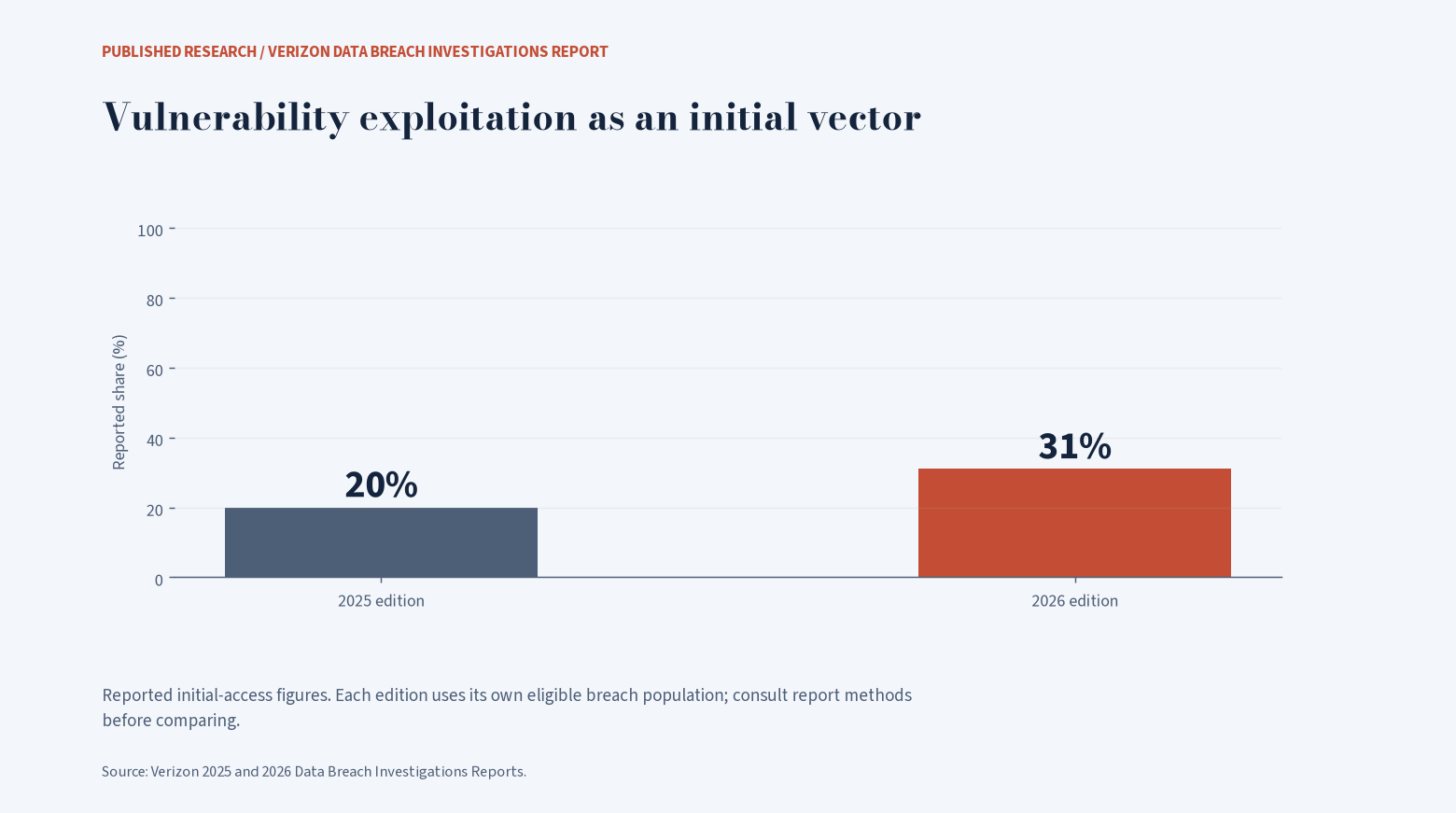
| Report edition | Reported share |
|---|---|
| 2025 edition | 20% |
| 2026 edition | 31% |
Use the finding to choose a relevant validation exercise, not to assign this percentage to your organization. Report editions describe contributed historical datasets; they do not measure the incidence of breaches across every organization.
Put it into practice
The practical starting point
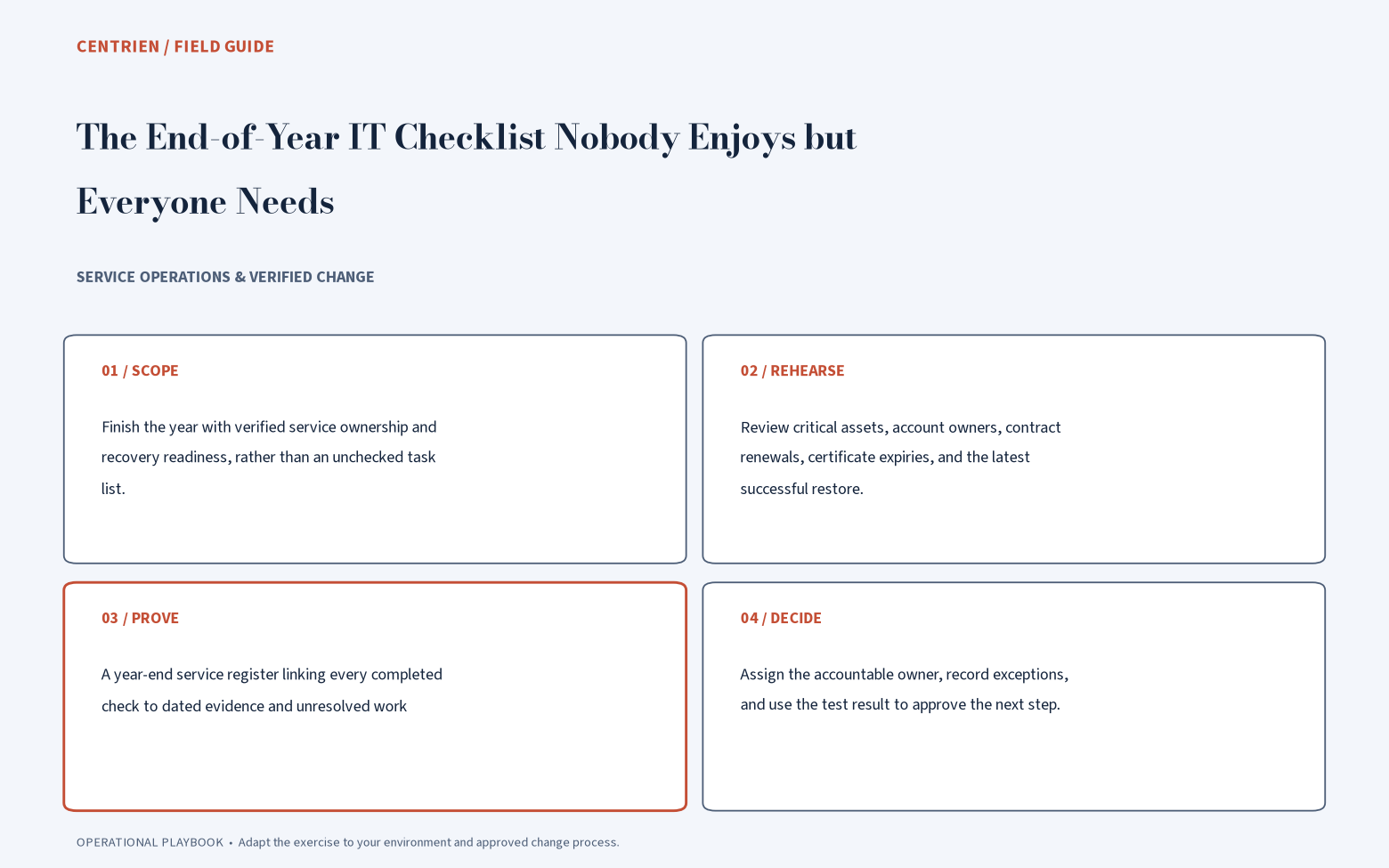
Review critical assets, account owners, contract renewals, certificate expiries, and the latest successful restore. Test one item from each list against the live service. Assign anything unverifiable to a named owner before marking the review complete.
Implementation steps
Use this sequence to assign responsibilities, test controls, and document outcomes. Set the scope and acceptance criteria for the service before you begin.
- Create a service recordList the business purpose, technical dependencies, owner, support contacts, maintenance limits, and recovery requirements. Verify the record against the service rather than copying an old inventory.
- Define a useful signalIdentify the event or condition that requires a decision. Check clock synchronization, missing telemetry, alert routing, and whether the recipient has enough context and authority to act.
- Make a reversible changeDocument the expected outcome, prerequisite checks, maintenance window, and rollback trigger. Test a representative workflow and verify monitoring before expanding the change to other systems.
- Close the operational loopRecord the actual result, affected users, unresolved exceptions, and any follow-up. Have the service owner accept the outcome and update the operating procedure while the evidence is available.
What to measure
Define the population and decision before choosing a target. The same percentage can conceal missing assets, untested cases, or evidence outside the review period. Keep the underlying counts so someone else can reproduce the result.
| Measure | Calculation or definition | How to use it |
|---|---|---|
| Service ownership coverage | Critical services with verified owners / critical services | Investigate records with missing dependency or escalation owners. |
| Actionable alarm coverage | Critical alarms with tested delivery and response / alarms in scope | A delivered notification alone does not prove a response. |
| Change acceptance | Changes with successful business validation / changes reported complete | Show rollback, partial success, and unresolved outcomes separately. |
Worked example: read the denominator
Worked example. Figures are illustrative.
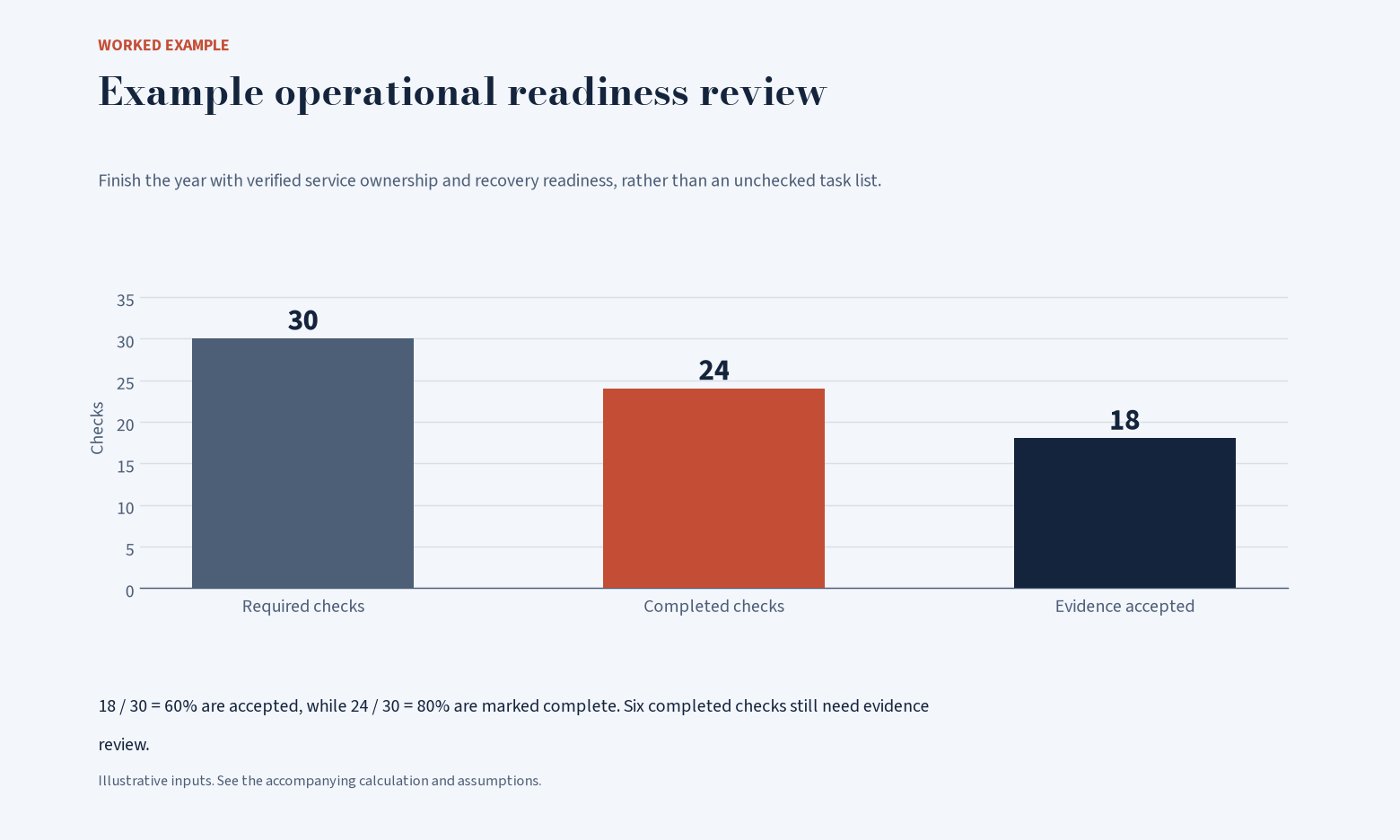
| Observation | Checks |
|---|---|
| Required checks | 30 |
| Completed checks | 24 |
| Evidence accepted | 18 |
Interpretation
18 / 30 = 60% are accepted, while 24 / 30 = 80% are marked complete. Six completed checks still need evidence review.
Use the distinction to direct review effort.
Use your own operating data and record the reporting period, scope, exclusions, and accountable owner.
Documentation and acceptance criteria
The deliverable: A year-end service register linking every completed check to dated evidence and unresolved work.
Keep the scope and source records alongside the operator, date, expected outcome, actual result, and approving owner. Record what was not tested and any remaining exception. Have a reviewer reproduce one material conclusion from the original evidence before marking the work complete.
Next step: Start with the exercise above, assign an owner, and agree on the acceptance criteria. Review the results before expanding the work.
References
- NIST Cybersecurity Framework — Use outcomes and organizational context to organize the risk discussion; a framework mapping is not a control test.
- NIST SP 800-61 Rev. 3: Incident Response — Connect preparation, detection, response, and recovery with the wider risk-management program.
Keep reading.

Compliance Frameworks Are Converging. Map Once, Report Many.
Reuse control evidence across frameworks only after confirming scope and assessment differences. Pick access review as a common control.
5 min read →
What a Real Disaster Recovery Test Looks Like
Call a disaster recovery test successful only when the business service is usable and reconciled. Recover one critical service into an isolated environment without relying on the normal production administrator.
5 min read →Refrigeration Alarms at 2 A.M.: Building a Response Plan That Works
Give a refrigeration alarm a response path that protects product and supports a sound disposition decision. Test sensor health, sustained alarm logic, acknowledgement, dispatch, and an alternative storage arrangement.
5 min read →