Why it matters
A walk-in cooler does not fail politely at 10 in the morning. It fails on a holiday weekend, at 2 a.m., when the one person who knows the system is asleep and the alarm is going to voicemail. By the time anyone notices, the product is gone and so is the margin.
The equipment matters, but the response plan matters more. A monitored temperature alarm is only useful if it reaches a human who can act, and most plans quietly break at that last step.
The three failures we see
First, the alarm goes to a person who left the company. Nobody updated the contact. Second, the alarm reaches someone with no authority or no vendor relationship to get a technician out before dawn. Third, there is no fallback — if the first call is missed, nothing escalates, and the freezer warms in silence.
What a plan that works contains
Monitoring that watches temperature continuously and alerts on trend, not just on catastrophic failure, so you hear about a cooler drifting before it is a cooler failed. An escalation chain with real people, verified quarterly, where a missed call rolls to the next person automatically. A standing relationship with service technicians who will actually answer at 2 a.m. And a documented loss procedure — what to move, what to discard, what to record — so the overnight staff is not improvising with your inventory.
The reason this gets neglected is the same reason cameras get neglected: refrigeration is “facilities,” monitoring is “IT,” and the service contract is a third thing. When they are not one plan, the 2 a.m. call falls into the gap between them.
We keep the equipment running, the monitoring honest, and the escalation list current — as one accountable service, so the alarm reaches a person who can fix it before you are counting spoiled product in the morning. Test your plan before the equipment tests it for you.
Put it into practice
The practical starting point
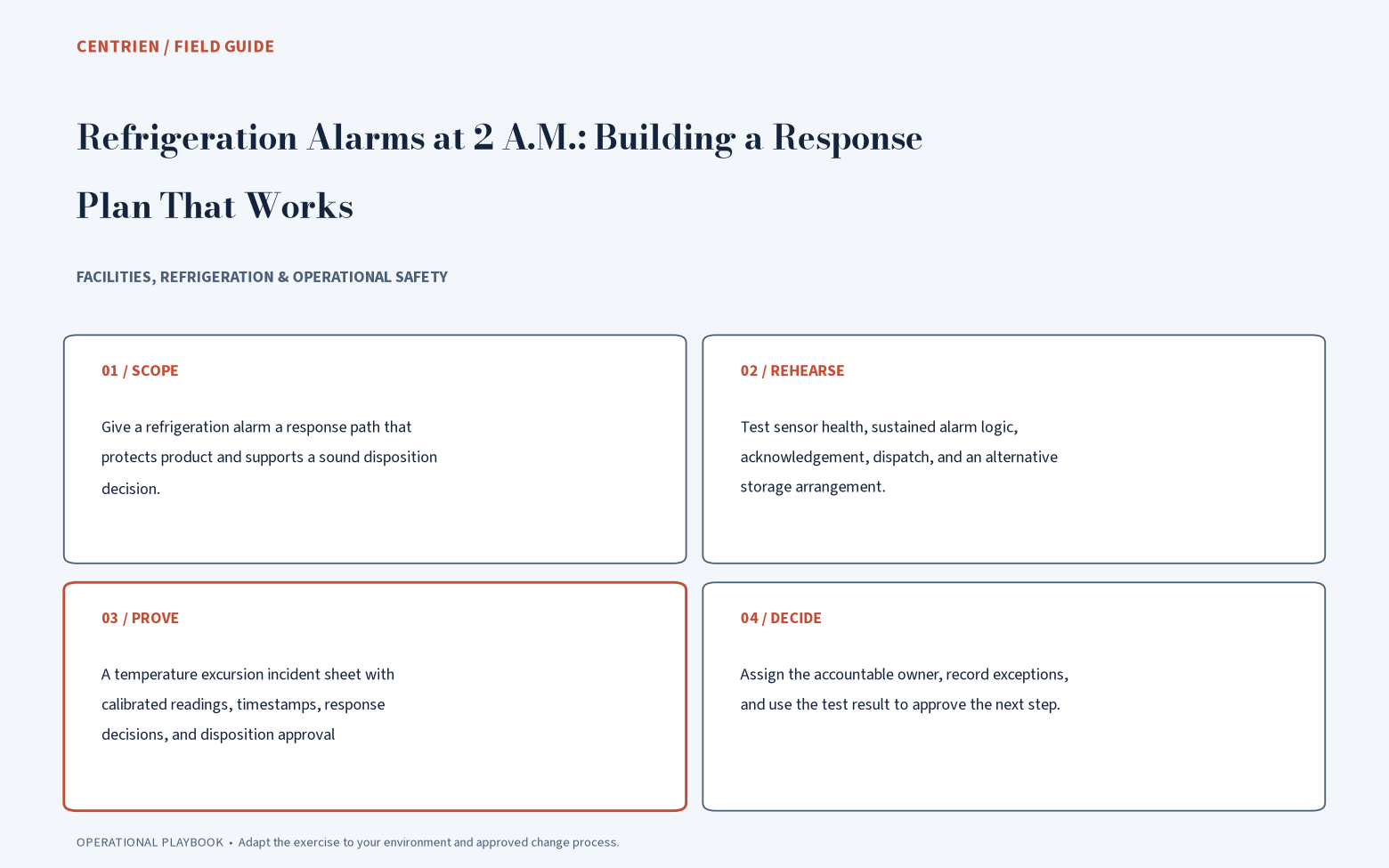
Test sensor health, sustained alarm logic, acknowledgement, dispatch, and an alternative storage arrangement. Preserve readings and elapsed time. Have the responsible food-safety or clinical authority determine product disposition using applicable requirements.
Implementation steps
Use this sequence to assign responsibilities, test controls, and document outcomes. Set the scope and acceptance criteria for the service before you begin.
- Establish equipment contextRecord asset identity, operating purpose, manufacturer instructions, service history, sensor condition, and safety or product constraints. Use the relevant professional to set equipment-specific limits.
- Measure comparable conditionsRetain timestamped readings and the conditions that influence them: ambient temperature, occupancy, loading, door openings, operating hours, or defrost state. Check sensor calibration and missing data before diagnosing a trend.
- Test the response pathValidate alarm persistence, delivery, acknowledgement, dispatch, and fallback operation through a supervised exercise. Keep safety functions independent and route electrical, combustion, and refrigerant work to qualified personnel.
- Verify the interventionCompare operation after the maintenance action under similar conditions. Record technician findings and any measurement limitations. Have the responsible authority decide product disposition or safety acceptance where applicable.
What to measure
Define the population and decision before choosing a target. The same percentage can conceal missing assets, untested cases, or evidence outside the review period. Keep the underlying counts so someone else can reproduce the result.
| Measure | Calculation or definition | How to use it |
|---|---|---|
| Maintenance verification | Required tasks with recorded inspection or test / tasks due | Use manufacturer and site-specific instructions for task scope. |
| Alarm-to-action time | Qualified response timestamp minus verified alarm start | Separate acknowledgement from an effective intervention. |
| Normalized energy use | Energy consumed / comparable operating exposure | Adjust for conditions before attributing savings to a change. |
Worked example: read the denominator
Worked example. Figures are illustrative.
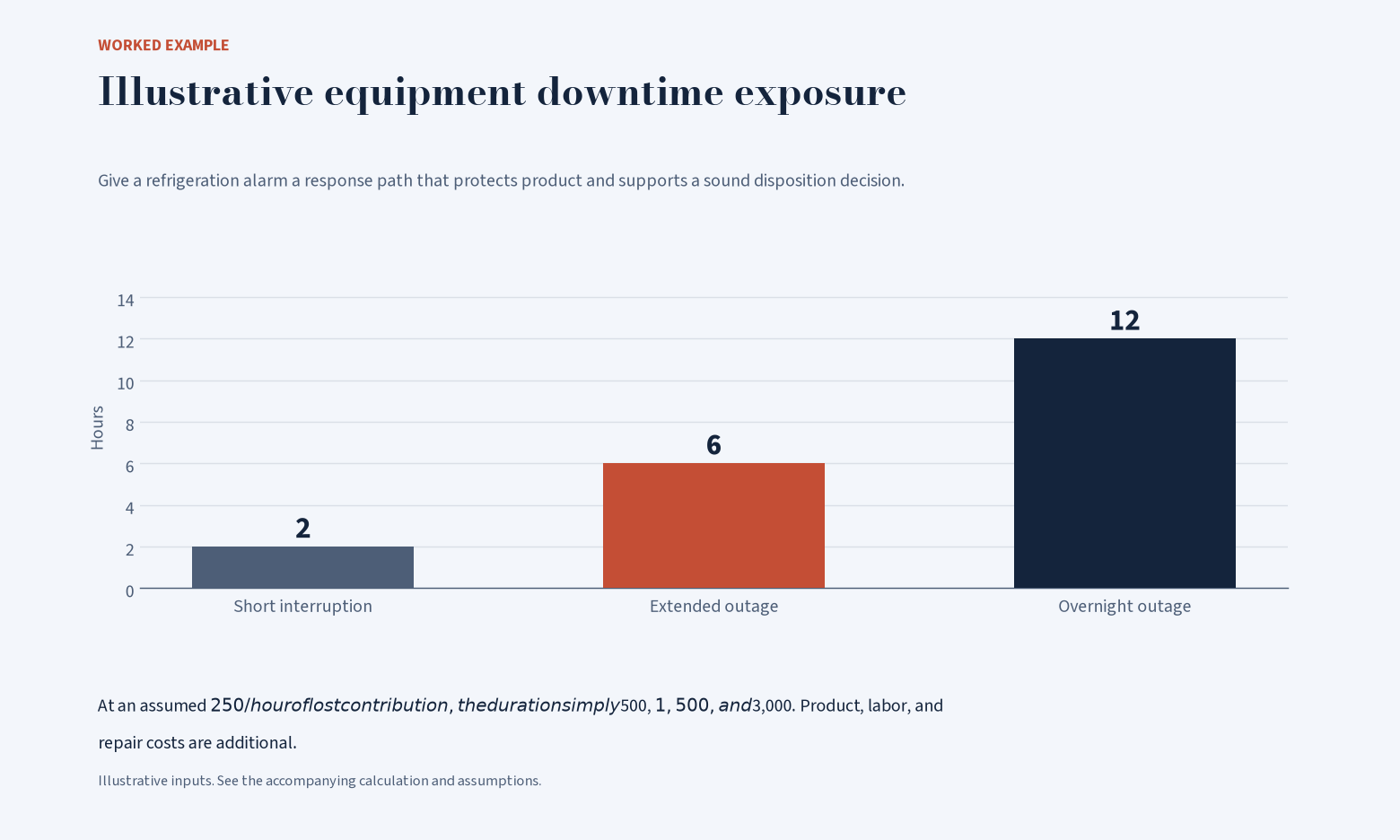
| Observation | Hours |
|---|---|
| Short interruption | 2 |
| Extended outage | 6 |
| Overnight outage | 12 |
Interpretation
At an assumed $250/hour of lost contribution, the durations imply $500, $1,500, and $3,000. Product, labor, and repair costs are additional.
Assess product loss, safety, and recovery costs separately from lost contribution.
Use your own operating data and record the reporting period, scope, exclusions, and accountable owner.
Documentation and acceptance criteria
The deliverable: A temperature excursion incident sheet with calibrated readings, timestamps, response decisions, and disposition approval.
Keep the scope and source records alongside the operator, date, expected outcome, actual result, and approving owner. Record what was not tested and any remaining exception. Have a reviewer reproduce one material conclusion from the original evidence before marking the work complete.
Next step: Start with the exercise above, assign an owner, and agree on the acceptance criteria. Review the results before expanding the work.
References
- U.S. Department of Energy: Operations and Maintenance Best Practices — Use systematic maintenance and measured operating conditions to investigate reliability and efficiency.
- NIST SP 800-82 Rev. 3: Operational Technology Security — Adapt security work to operational technology performance, reliability, and safety requirements.
Keep reading.

The End-of-Year IT Checklist Nobody Enjoys but Everyone Needs
Finish the year with verified service ownership and recovery readiness, rather than an unchecked task list. Review critical assets, account owners, contract renewals, certificate expiries, and the latest successful restore.
5 min read →
Compliance Frameworks Are Converging. Map Once, Report Many.
Reuse control evidence across frameworks only after confirming scope and assessment differences. Pick access review as a common control.
5 min read →What a Real Disaster Recovery Test Looks Like
Call a disaster recovery test successful only when the business service is usable and reconciled. Recover one critical service into an isolated environment without relying on the normal production administrator.
5 min read →